| |
|||||
|
Having briefly introduced you to our cooling system and its many benefits on our Main page, you may be asking, “How is it possible to gain power from a cooling system?” The following will provide a brief illustration of our NPG and the technology it incorporates. More detailed technical information along with a number of charts outlining the various properties of our NPG Coolant is available below. For a more comprehensive discussion of NPG, pleae read our NPG Benefits page. NOTE: FOR ALL THE BENEFITS OF NPG AND MORE, PLEASE READ ABOUT OUR NEW NPG+. |
Like all competition engine builders, Jack Evans spent years working to find a way to run race cars faster without damaging levels of detonation, pre-ignition knock, and internal engine damage. His conclusion was that water in the cooling system was the cause of existing problems and a substitute coolant needed to be developed to allow engine development to move forward.
Through rigorous testing on dynamometers, at race tracks and in climate controlled OEM laboratory environments, Evans developed and quantitatively proved a new cooling technology by eliminating the use of water. The new coolant, EVANS Non-Aqueous Propylene Glycol (NPG), has an efficiency considerably superior to conventional coolants and has a boiling/vaporization point considerably higher than conventional water-based coolants. The end result is greater thermal efficiency and fuel mileage while at the same time reducing detonation, pre-ignition emissions and wear. Better yet, EVANS NPG Coolant is essentially non-toxic, non-corrosive, and operates with zero pressure.
After ten years of development and testing with vehicle manufacturers, over-the-road truck fleets, and some pretty hard hitting race teams, EVANS NPG Coolant and coordinated cooling systems components are a reality. The best news is that EVANS NPG Coolant and all of the associated components are available from the leader in the development of automotive cooling systems, designed individually for YOUR race car or high performance vehicles.
Gain
Power From Your Cooling System
Run Faster, Run Better? How Do You Do It?
Race engines have the capacity of operating at much higher efficiencies and power production levels than used at today's limits, but there has been no practical way to accomplish this without causing localized coolant boiling and the resultant destructive detonation. When this happens, the coolant loses it's ability to absorb heat from that particular area of the combustion chamber, developing high temperature spikes. The result is detonation or component structural metal failure.
Evans Cooling Systems, Inc. Breakthrough:
Evans NPG Coolant and related components are designed with the ability to reduce hot spots while raising the coolant boiling point and decreasing the volume of vapor generated when compared to typical ethylene glycol / water (EGW) mixtures. Race car testing has shown that even if forced to operate at up to 300° F, detonation control and previously forbidden combustion pressures and temperatures are no longer the danger they were to thermal engine efficiency and durability.
Traditional Systems Shortcomings
Within all cooling systems is the normal occurring phenomenon called Nucleate Boiling:
What Is Nucleate Boiling?
Nucleate boiling is the boiling that takes place when liquid coolant comes in direct contact with the hot metal of the engine block or cylinder heads which has reached or exceeded the boiling point of the coolant.
Under these conditions, the liquid turns to a vapor as it boils at the hot metal surface, and will then finally break away to be replaced by additional liquid coolant. Very large amounts of heat are absorbed into this layer of liquid coolant from the metal surfaces of the engine, yet those surface temperatures in a controlled nucleate condition never rise much beyond the boiling point of the coolant, and thermal control is maintained. Nucleate boiling is reduced or eliminated when the coolant itself becomes continuously displaced from the metal surface by a layer of vapor called a "film blanketing" (surface) layer. When blanketing occurs, the metal surface becomes insulated from the surrounding liquid coolant, and an ever - increasing localized high temperature spike develops.
(A) The loss of Nucleate Boiling, the common problem with conventional water based coolants.
The loss of Nucleate Boiling causing a vapor blanket to be formed as the metal temperature has exceeded the thermal capacity of a water-based coolant. A hot spot develops because the vapor blanket keeps the coolant from contacting the hot spot and increased detonation results. The very high surface tension of the water-generated steam promotes the formation of the vapor blanket and eventually destructive levels of pre-ignition ("knock") occur. Sustained Nucleate Boiling reveals continuous heat transfer through the uninterrupted liquid-to-metal contact of the NPG Coolant.
(B) Demonstrates high engine load sustained "Nucleate Boiling", free of surface vapor blanketing, attainable only with Evans NPG Cooling.
Sustained Nucleate Boiling reveals continuous heat transfer. The relatively low surface tension of NPG Coolant aids in the breaking away of vapor and the movement of coolant across the hot spots, controlling surface vapor and surface coolant replenishment. The result, lower metal temperatures at the hot spot in each cylinder.
Evans NPG Cooling Maintains Nucleate Boiling Conditions
Testing history and experience tell us that conventional coolant systems always experience a loss of nucleate boiling which then originates and increases the condition of surface film vapor blanketing whenever an engine is in a high load or temperature operation. It is no surprise that auto makers as well as after market manufacturers have been combating this problem with multitudes of accessories, additives and applying performance limitations on engine design. By contrast, the Evans NPG Cooling Technology has eliminated the problem!
Evans NPG Coolant; The No Water Coolant Breakthrough
Evans NPG Coolant is inhibited 100% propylene glycol. Evans NPG Coolant can maintain a substantially vapor free liquid to metal contact (nucleate vapor only) at all coolant temperatures and engine loads. Additionally, the small amount of vapor generated during nucleate boiling is easily swept off the metal surface and then completely condensed within the coolant jackets of the cylinder heads thereby never passing on to the radiator.
The Evans NPG Cooling System is Non - Pressurized
That's right, the Evans NPG System eliminates the pressure cap - the cooling system works with no system pressure. Evans NPG Coolant's incredible atmospheric thermal capacity eliminates any need of a pressure assist to bolster its capabilities. This advanced coolant and cooling system also yield corrosion-less cooling by the total elimination of water and the unique, long life corrosion inhibiting formula.
Why No Water?
Because anything else with a low boiling point in the system, such as water, causes the loss of nucleate boiling. In fact, water is a contaminant to the proper working of the new system and is eliminated by the Evans Technology which continuously moves it out of the cooling system.
Increases the Longevity Of Your Cooling System!
Beyond the distinct safety advantages of a non - pressurized cooling system, Evans NPG Cooling Systems will vastly reduce your car maintenance costs. Evans NPG Coolant virtually eliminates all three major forces (high pressure, water and air) that are detrimental to conventional ethylene glycol and water pressurized cooling systems and their longevity. Now it is possible for your high performance cooling system components to last up to 100,000 miles.
Note: Evans NPG Cooling Systems have been successfully installed in thousands of vehicles worldwide. Several test vehicles have used the coolant for over 500,000 miles without a major component replacement, changing coolant or having additive levels fall outside of manufacturing tolerances. The additives do not deplete and the radiator core tubes do not clog.
A True "Bolt - On" System
You
can attain all of the benefits of the Evans NPG Cooling System with ease.
Quite simply, Evans NPG Cooling Systems require no major mechanical changes,
just a parts exchange. You may need the specialized NPG coolant pump,
NPG radiator with a non - pressurized radiator cap as well as the new
Evans NPG Coolant. (See our Catalog
page for details.) With a few tools and our easy to follow, step - by - step,
instructions, you can easily and
safely convert your vehicle to the Evans NPG Cooling Systems in a couple
of hours.
Run
Faster –
Run Better –
Never Overheat –
![]() |
|
Evans
NPG Cooling Systems are available in custom configurations to suit virtually
any application.
|
Competition engines can operate with much higher efficiencies which lead to higher power production. The limiting factor has always been the conditions imposed by water-based cooling systems, including low boiling point excessive vapor generation. These conditions cause localized coolant boiling, vapor blanketing at hot spots and the resultant destructive detonation and pre-ignition. When vapor blankets the surface, water-based coolants lose their ability to absorb heat from the hot spots in the combustion chamber, leading to high metal temperature spikes well above critical detonation levels. The result is loss of power from detonation or component structural failure from pre-ignition in the form of piston damage, head gasket failure, and/or warped or cracked heads.
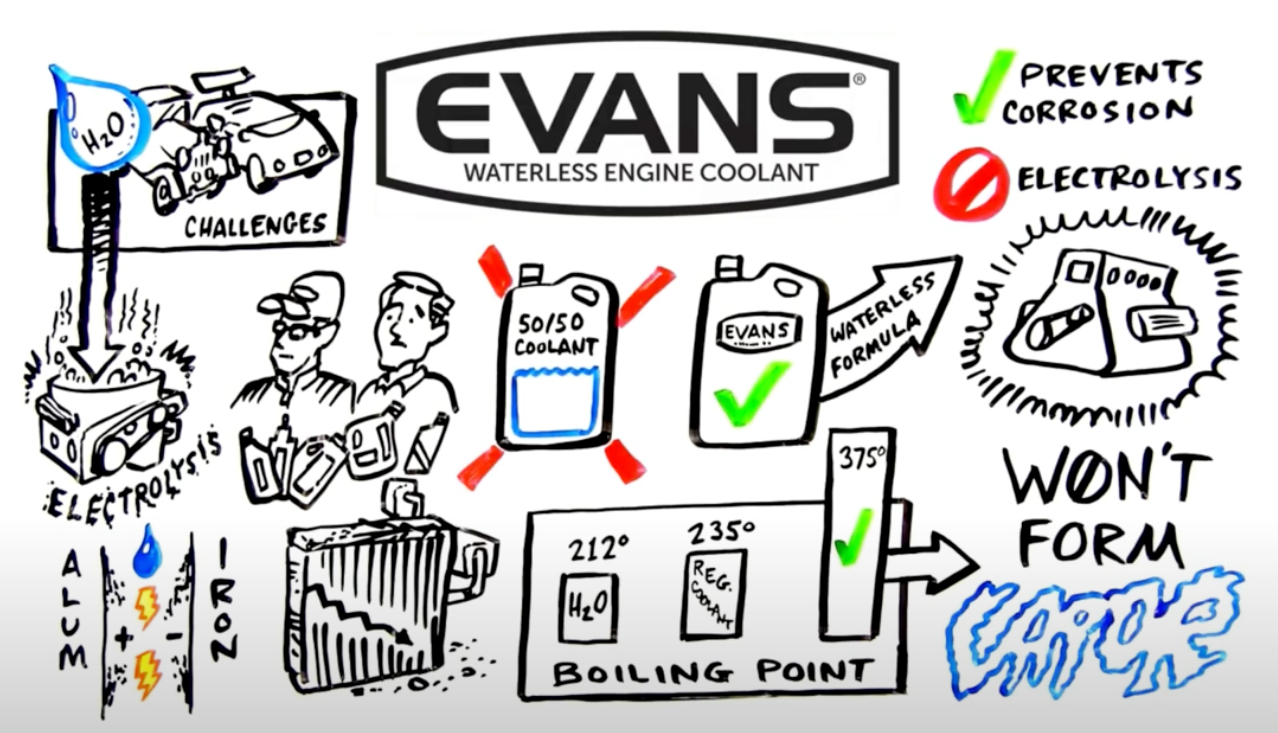
The boiling point of EVANS NPG Coolant is 370°F, in a non-pressurized system. On-track testing, in both Evans owned and Evans sponsored race cars has shown that even if an EVANS NPG Cooling system is forced to operate at temperatures up to 300° F, detonation / pre-ignition control and previously forbidden combustion chamber pressures and temperatures are no longer the danger they were to thermal engine efficiency and durability.
Evans NPG Coolant Is Used Without Water and Without Pressure
Evans NPG Coolant is 100% Inhibited Propylene Glycol. It can maintain a substantially vapor free, liquid to metal contact at all coolant temperatures and engine loads. By bathing the entire combustion chamber with coolant 100% of the time, metal temperatures are controlled to such an extent that critical levels of detonation and pre-ignition are never reached. Because of NPG’s naturally high 370° boiling point, the need for adding high pressure to the cooling system is eliminated. Without pressure (or low pressure, i.e.: 4 - 7 psi) in the system, gasket seals, hose connections, and even the radiator core, operate safer and longer.
Power Loss In 4 Seconds?
There are several important advantages for using EVANS NPG Coolant in drag racing. Our work with several top Pro Stock and competition engine builders has shown power loss as soon as 4 seconds into a run with water-based cooling systems. NPG totally eliminates critical hot spots which cause excessive detonation, pre-ignition, and power loss.
If the engine is to be used in an Open Class car where maximum horsepower is desired, the elimination of combustion chamber critical hot spots and the resultant loss of power (see page 2) remains the key benefit. The need for controlling combustion chamber temperatures is even more critical in a quarter mile race than most racers realize. The drop in power (no matter how slight) for even one or two seconds due to detonation will result in a substantial loss of acceleration and an increase in ET. Additional problems of parts destruction caused by cooling system induced excessive detonation and pre-ignition levels are completely eliminated when NPG Coolant is used. The addition of an EVANS high flow coolant pump and a low restriction aluminum radiator is highly recommended to maximize the potential of NPG Coolant.
When the application is for a Bracket Class car where "running the numbers" round after round is required, NPG Coolant will provide consistent and controlled combustion chamber critical metal temperatures. This control will provide the racer the ability to repeat performance combinations. Racers can then spend the time between rounds attending to more important tuning chores and not be burdened with "cooling down". Once again, to maximize the performance of an EVANS NPG Cooling system, the EVANS high flow pump and a low restriction radiator are highly recommended.
Taking NPG To The Street
![]() |
|
Evans
NPG Cooling Systems are available for Street Rods, Muscle Cars, and late
model Street Machines.
|
The use of NPG Coolant and Evans Cooling Systems components in Street Rods, Muscle Cars, and Hi-Performance Street Machines has many benefits. First and foremost is NPG's ability to control engine generated heat and never boil over or fail. By their very nature, Hi-Performance, street driven vehicles have engines which produce high levels of heat, and then have to pass that heat into the air through radiators which in many cases are too small to accomplish the job. The use of NPG Coolant helps to correct this imbalance. The addition of an Evans coolant pump and/or the use of an aluminum high flow radiator will greatly assist in the balancing of the cooling system components to the heat generated.
By operating the cooling system with either a 4 to 7 psi radiator cap, or as a non-pressurized system, virtually all common failures such as leaking head and manifold seals, broken hoses and radiator core leaks are eliminated. NPG Coolant provides corrosion free operations with a coolant and component life expectancy in excess of 10 years or 100,000 miles.
New Technology For Old Cars
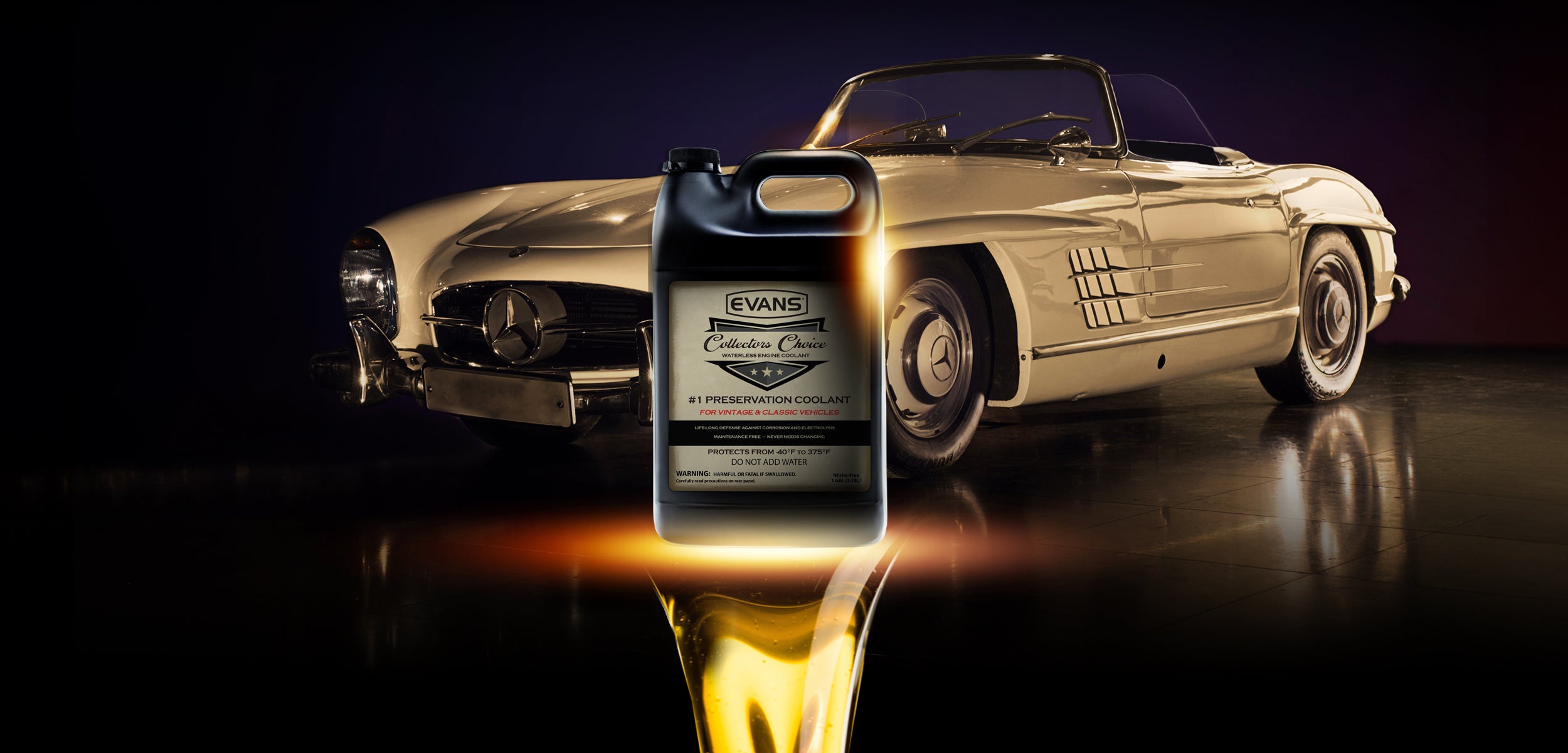
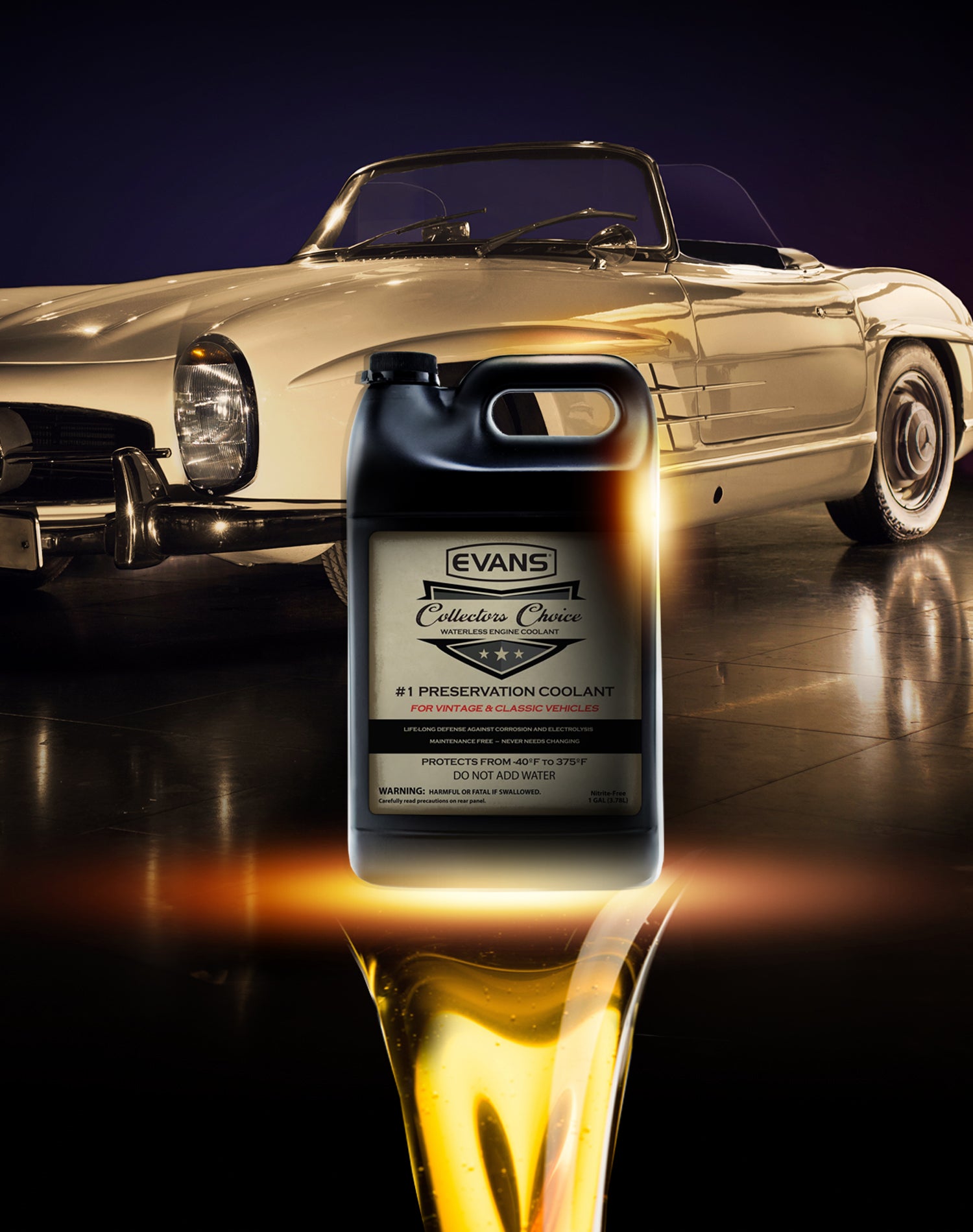
EVANS NPG Coolant is the perfect choice to control and maintain all vintage, antique and collector cars with the original stock engines and cooling system components. The non-corrosive and virtually nontoxic nature of NPG Coolant provides the collector car owner the maximum protection for his investment while at the same time eliminating the possibility of creating a toxic waste problem in his garage or driveway. The exclusive formulation of EVANS NPG Coolant provides protection for vehicles while in storage as well as when on tour. It has been chosen by several nationally recognized museums to protect their vehicles during years of inactivity.
Due to the typical low compression ratios and horsepower of vintage, antique, and collector cars, NPG can be used in most cases without any modifications to existing cooling system components.
| Water | 50/50 EGW | Evans NPG | Evans NPG+ | ||
| Boiling Point | 121°
C (250° F) (1 atm plus 15 psig) |
129°
C (264° F) (1 atm plus 15 psig) |
187°
C (369° F) (1 atm plus 0 psig) |
191°
C (375° F) (1 atm plus 0 psig) |
|
|
|
|||||
| Viscosity | |||||
| 10° C (50° F) | cp | 1.2 | 5.0 | 115 | 58 |
| 80° C (176° F) | cp | .37 | 1.0 | 4.5 | 3.7 |
| 100° C (212° F) | cp | .28 | 0.7 | 2.8 | 2.3 |
|
|
|||||
| Density | |||||
| 20° C (68° F) | spec grav | 1.00 | 1.066 | 1.038 | 1.091 |
| 20° C (68° F) | lbs/gal | 8.32 | 8.87 | 8.64 | 9.08 |
|
|
|||||
| Specific Heat | |||||
| 80° C (176° F) | Btu/lb/°F | 1.00 | 0.81 | 0.68 | 0.64 |
| 100° C (212° F) | Btu/lb/°F | 1.01 | 0.82 | 0.71 | 0.66 |
|
|
|||||
| Heat of Vaporization | cal/mole | 9,700 | 9,800 | 12,500 | 12,050 |
|
|
|||||
| Vapor Pressure | |||||
| 80° C (176° F) | mm Hg | 360 | 270 | 8 | 6 |
| 80° C (176° F) | kPa | 475 | 360 | 11 | 8 |
|
|
|||||
| Surface Tension | |||||
| 25° C (77° F) | dyn/cm | 72 | 56 | 36 | 44 |
|
|
|||||
|
NOTE: FOR ALL THE BENEFITS OF NPG AND MORE, PLEASE READ ABOUT OUR NEW NPG+. |
|
|
|
|
This
page is part of a framed web site. Click the button to load the site from
the intended starting point. |