
|
INSTRUCTION MANUAL: Evans NPG+ “Waterless” Cooling Systems
|
| WARNING: TO AVOID THE POSSIBILITY OF ENGINE DAMAGE USE ONLY UNDILUTED EVANS NPG™ (Non-aqueous Propylene Glycol) or NPG+™ COOLANTS IN AN EVANS “Waterless” COOLING SYSTEM. |
|
WATER IS CONSIDERED TO BE AN IMPURITY, AND HARMFUL TO THE SYSTEM. Other forms of propylene glycol, the base for EVANS “Waterless” Coolants, have either 1) no additives formulated for metal corrosion, or 2) improper additives for use with EVANS Cooling Systems. If other than EVANS properly inhibited coolant is installed, boiling within the engine-cooling jacket will react with engine metals resulting in damage from corrosion, metal erosion and coolant gelling. 3) System must be drained including the block and heater core. |
|
SAFTEY PRECAUTIONS
|
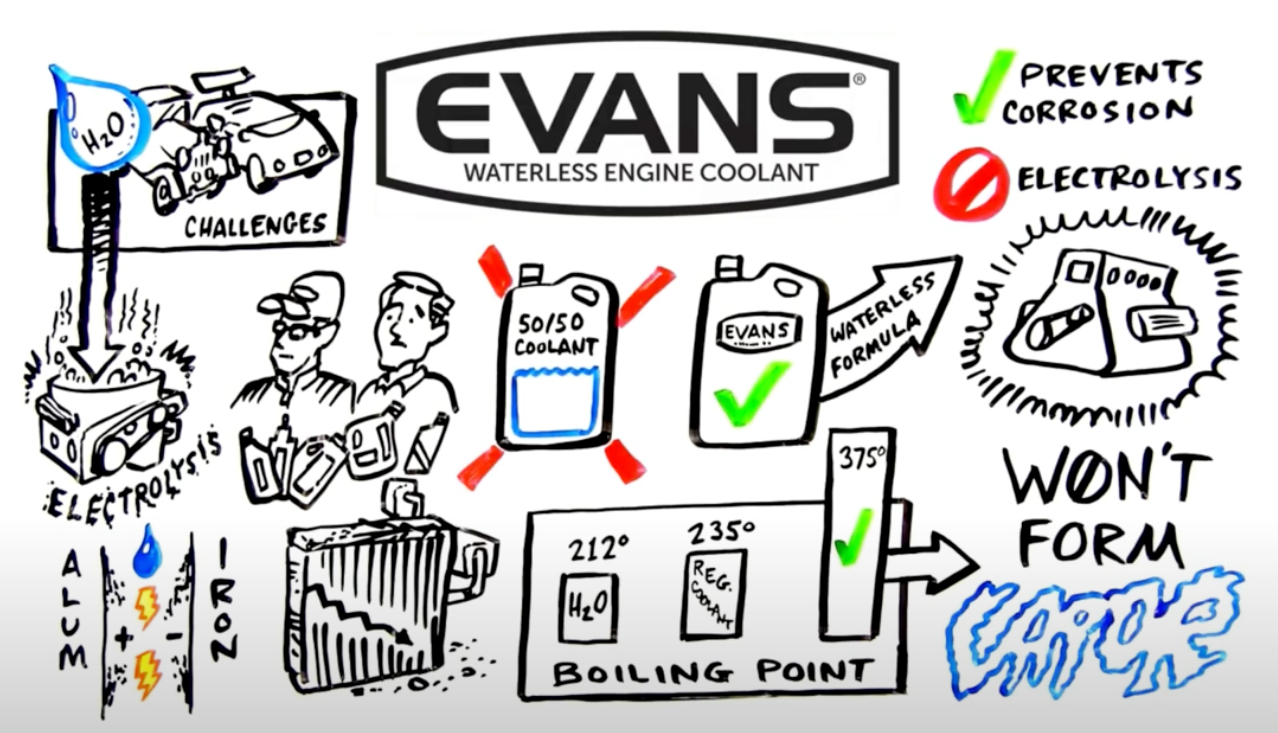
TECHNICAL DATA Boiling & freezing points of different coolants |
Boiling point | Freezing point |
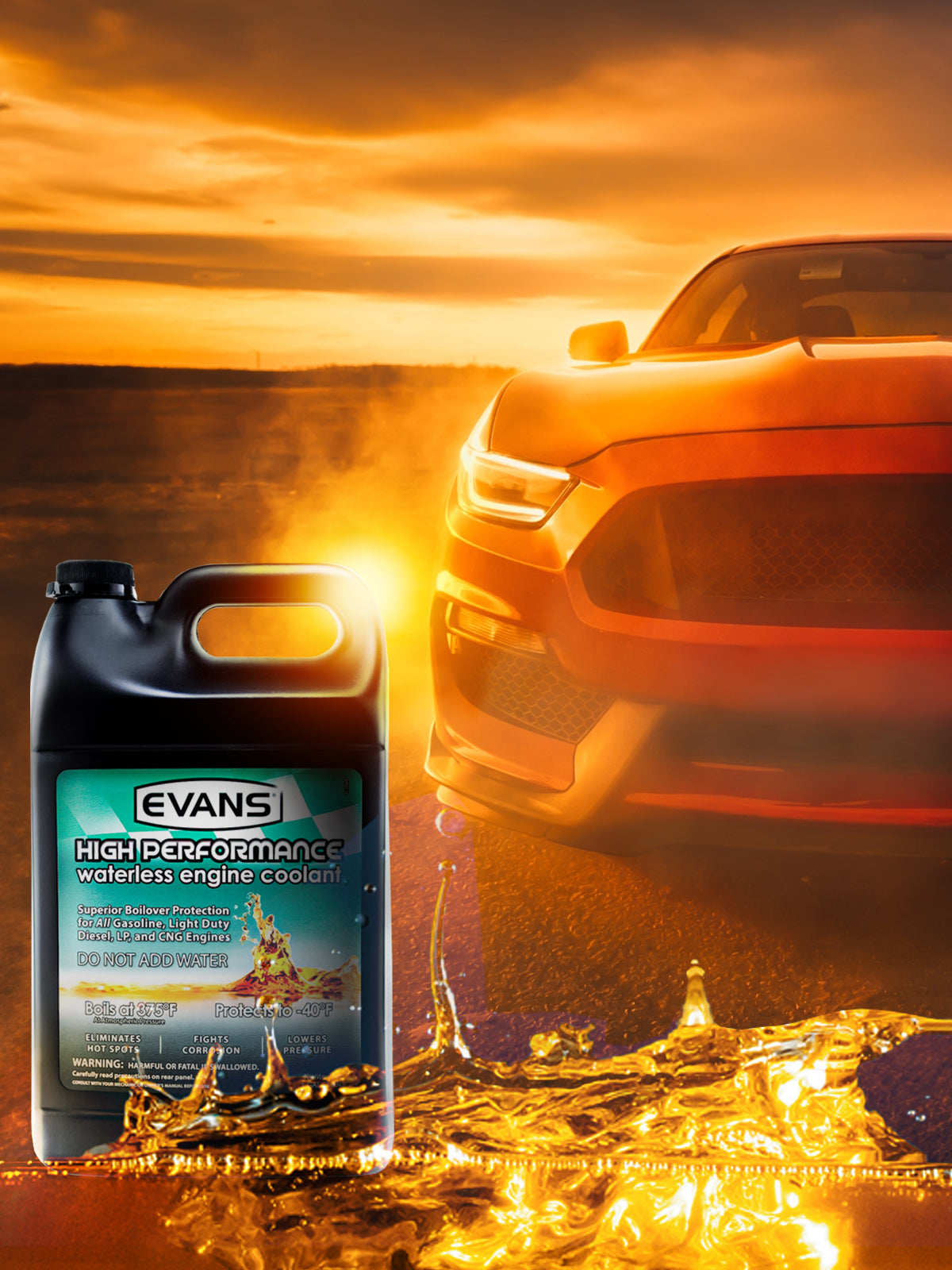
| EVANS NPG+ Coolant | 375 °F, at Zero psi | -40 °F |
| EVANS NPG Coolant | 367 °F, at Zero psi | -79 °F |
| 100% Water | 212 °F, at Zero psi | 32 °F |
| 50/50 Water/Ethylene Glycol | 255 °F, at 15 psi | -30 °F |
| Minimum radiator core suggestions for Street Rod, Performance and Racing Vehicles | ||
| 300HP or less without A/C | 4 rows 1/2” tube copper/brass. | |
| 300HP or less without A/C | 4 rows 1/2” tube copper/brass. | |
| 300HP to 400 HP with A/C | 2 rows 1”tube aluminum. | |
| 400HP plus | minimum of 2 rows 1.25” tube aluminum | |
| System information and suggestions |
A common misconception that EVANS “Waterless” Cooling System will operate hotter than water-based cooling systems. With a properly installed system, using the recommended pump and radiator with nothing else changed, the system will operate at the same temperature or often at a slightly lower temperature compared with a system operated on water-based coolant. However, if a major change is made to the fuel mixture or to increase compression, horsepower, or turbo boost, the system will operate hotter due to the higher output of the engine. Operating the engine at limits beyond conventional cooling capabilities will cause a conventional cooling system to run excessively hot, overheat and fail. The EVANS Cooling System will continue to operate, FAILURE FREE at that higher temperature (up to 280°F) without engine damage. However, whenever operating an engine at high coolant temperatures the oil temperature must be controlled and kept to a maximum of 250 °F, by using an oil cooler. |
| Thermostat and thermostat bypass hoses |
With “Waterless” Coolants the thermostat is not needed in Hi performance systems, or for warm weather application. For cold weather applications or computer controlled engines install a Evans High Flow or Evans total flow thermostat of the proper temperature. Systems that use bypass type thermostat must plug the bypass port when removing the thermostat. Large suction (inlet) side bypass thermostats can bypass small quantities of coolant due to the higher suction pressures created by the pump. This could result in slightly higher operating temperatures. To correct - install the Evans total flow thermostat in the upper (pressure) hose. The bypass hose connects the intake manifold with the water pump suction side, BB Chevy, SB&BB Ford, SB MOPAR all use a thermostat bypass hose that is unnecessary for HIGH PERFORMANCE use. Plugging the bypass hose forces all the coolant to flow though the radiator. The plug should be made of metal and large enough to seal the ID of the hose. Pipe plugs can be used to eliminate the hose completely. CAUTION: After blocking the bypass circuit, only the specially designed EVANS Hi Flow or Total Flow Thermostat should be used or engine damage may occur. For leak problems, Bars Leak Tablets or AlumiSeal are the only approved stop leak product for “Waterless” Coolants. Evans STOPLEAK Tablets are also available. When using a coolant pump other than an Evans pump the weep hole must be plugged. Use of a 7 lb. cap on “waterless” system is recommended for racing, street rod and performance enhanced vehicles. For applications where 7 lb. cap is not available, standard cap may be used. All stock – factory original computer controlled daily driven vehicles are coolant change only – no system changes are required. |
| Hi Performance Suggestions |
Install hi performance aluminum tube radiator. |
| Maximizing Racing Systems |
Convert the upper hose and thermostat housing to 1 3/4”OD. |
|
INSTRUCTION INFORMATION |
| DRAINING OF OLD COOLANT |
COOLING SYSTEM MUST BE DRAINED COMPLETELY, RADIATOR, BLOCK, HEATER! CAUTION: Ethylene glycol is poisonous. Do not leave it in an open container. Always use a drain pan to capture all fluid in compliance with local, state and federal laws. If drained fluid contains ETHYLENE GLYCOL, it must be disposed of as HAZARDOUS WASTE. |
| Flushing and Cleaning |
All water and remaining coolant must be removed from the system prior to installing EVANS “Waterless” Coolants. The engine and system must be completely drained, if necessary, use Evans PREP Fluid as a flush, or use the hot-purging technique for residual water. When converting older systems a chemical flush should be used to clean the system prior to flushing and installing Evans “Waterless” Coolants. To insure that all residual coolant is evacuated from the heater core, disconnect both heater hoses at the engine side of the heater, lower one hose into a drain pan and very gently introduce air into the other hose until fluid is fully drained. It is advisable to pour the EVANS PREP fluid, into the higher of the two heater hoses until it visibly flows from the draining hose in order to flush out old coolant. |
| HI PERFORMANCE & RACING INSTRUCTIONS | ||
| NPG coolant acceptable by most racing sanctions where stipulated as “no antifreeze”, verify from your rulebook coolant requirements. If no specific antifreeze ruling exists - NPG+ may be used. | ||
1. |
THE BLOCK MUST BE DRAINED! The system completely empty and as clean as possible. |
|
2. |
REMOVE THE THERMOSTAT OR RESTRICTOR. | |
3. |
PLUG THE THERMOSTAT BYPASS HOSE. | |
4. |
Install Evans Full Time Bleed Line (#EFTBK) in the pump and connect to intake manifold. A manual pump bleed is an option. | |
5. |
If the radiator cap is on the thermostat housing - it must be removed or made a sealed fill cap with no pressure setting. Low-pressure cap cannot be used in this location due to being the pressure side of the system – cap will vent. | |
6. |
Install an expansion tank with a cap (zero or 7psi) that is plumbed into the suction side (lower hose). Minimum capacity 2 quarts. | |
7. |
Attach all hoses and replace all plugs, open manual air bleed and fill the system with NPG. Close air bleed when NPG appears. | |
8. |
Install the self adhesive round “Evans” decal provided, on the radiator cap or close to the fill location. | |
9. |
When using an expansion tank or remote fill location, fill radiator to the top and install radiator cap,(zero or 7 psi) then fill the expansion tank half full. | |
10. |
Start the engine and bring it up to operating temperature. Open manual air bleed if possible to bleed any air that has been trapped in the pump. | |
11. |
Stop engine and allow to cool. Check expansion tank level and adjust as required. | |
12. |
For the next few times operating the vehicle check the level in the expansion tank and add Evans NPG as required. | |
| REAR COOLANT LINE INSTALLATION INSTRUCTIONS | ||
1. |
Locate rear water passage on each side in the heads. Normally between the last 2 bolts on the intake manifold. | |
2. |
Drill and tape a hole for ½”NPT into the water passages. If manifold is not thick enough to tap correctly, a ½”NPT bung should be welded in place. Removal of the manifold may be required. | |
3. |
Install thermostat riser under thermostat housing with the (2) ½”NPT facing the rear of the engine. | |
4. |
Connect the new rear water outlet to the thermostat riser with hoses and fittings of your choice. | |
| HEAVY DUTY DIESEL NPG+ INSTRUCTIONS | ||
1. |
Drain complete system, including radiator - engine block - heater circuit (gently blow air through heater circuit). |
|
2. |
Expansion Tank - make sure is completely empty and dry. | |
3. |
Drain any ancillary circuits and gently blow out with air (i.e. fuel heater and brake air compressor circuits). | |
4. |
Reconnect all circuits and close any drains. | |
5. |
Engines using a coolant filter, filter should be replaced with a blank filter. | |
6. |
Fill system completely with Evans NPG+. | |
| DO NOT ADD ANY WATER – DO NOT “TOP OFF” WITH WATER | ||
7. |
Replace radiator cap. | |
8. |
Apply Evans Do Not Add Water warning decal. | |
9. |
Run engine until it is warm and thermostat opens. | |
10. |
Installation test: CHECK COOLANT LEVEL. LESS THAN 3.6% WATER IN SYSTEM IS ACCEPTABLE - MAY BE CHECKED WITH A Brix scale REFRACTOMETER. | |
| 11. | Post installation: CHECK COOLANT LEVEL DAILY UNTIL COOLANT LEVEL STABILIZES; ADD EVANS NPG+ COOLANT AS NEEDED. | |
| Note: If the system uses an electric conductance low-level coolant sensor, check to see if it operating properly; if not, it will need a modified conductance spring. All “float” type sensors will operate without any problem. | ||
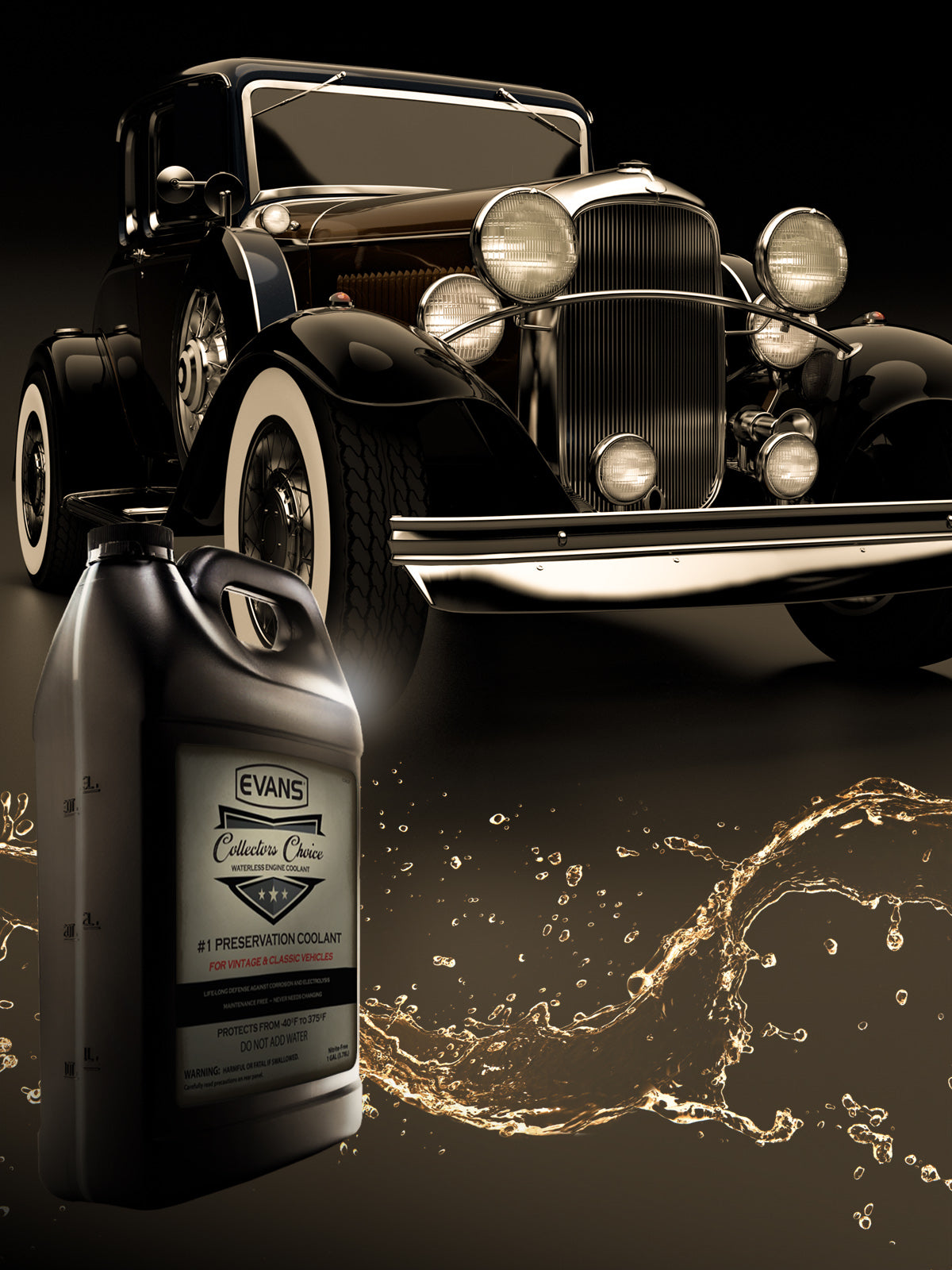
| ANTIQUE/ COLLECTOR/DAILY DRIVER INSTRUCTIONS | ||
1. |
Drain and flush the entire system including the block and heater. By removing hoses and opening drains. |
|
2. |
Replace all hoses and drains and fill the engine and radiator with Evans “Waterless” Coolant. | |
3. |
Fill the expansion tank half full. | |
4. |
Install the self adhesive round “Evans” decal provided, on the radiator cap or close to the fill location. | |
5. |
Start the engine and allow it to reach normal operating temperature. Turn the heater on high, and check the coolant level in the tank. | |
6. |
Adjust the level in the expansion tank to half full. Replace the radiator cap. Monitor the level in the expansion tank the next couple of times the vehicle is driven. Once the system is stabilized the coolant level in the expansion tank should stay half full at normal operating temperature. | |
7. |
For problem systems: see Hi performance /Racing instructions. | |
| Note: If you are unable to drain the block there are two options. (1) Fill ½ the system capacity with Evans PREP Fluid, run engine until the thermostat opens and normal operating temperature is reached. Continue to idle system for up to 30 minutes. Drain out Evans PREP Fluid and dispose of properly. Fill system with NPG+ Coolant. The result should be less than 5% by volume of residual water remaining. Or (2) Flush with water and perform the HOT PURGE procedure. | ||
| HOT-PURGING OF RESIDUAL WATER FROM COOLANT AFTER INSTALLATION | ||
| Hot purge procedure can not be used on computer controlled vehicles. If all drains were opened prior to NPG+ installation – Hot purging procedure is not needed. | ||
| After the initial conversion from the conventional water based system when block drains were not removed - residual water often remains in the engine. To purge, first drain the expansion tank, if high mounted, then disconnect the vent line from the inlet side (toward the engine/radiator). Using an additional hose, temporarily connect the separated portion of the vent hose to a high point (such as the raised hood) and direct remainder of the hose to the ground. Cover the front of the radiator with a fender cover or cardboard to block the flow of the air through the radiator core. Start the engine and warm up to approximately 280°F at idle speed. NOTE: If there are trace amounts of water remaining in the system, idling the engine at 280°F will cause only water vapor in the form of steam, not coolant, to blow out of the vent line. | ||
| If your vehicle does not have a gauge, which reads 280°F, then use a thermocouple or a simple metal (probe-type) oven thermometer. Best method is to loosen a hose clamp, slide the thermometer probe under the hose until it contacts coolant, and then tighten the clamp. An alternate method is to tightly wrap the probe of the thermometer to the hose. | ||
| WARNING: HOT Residual water, if present, will vent rapidly from the vent line as steam (water vapor). Be certain no one is near the vent line during the initial purge of such water vapor. | ||
| Hot purge procedure as follows: | ||
1 |
If steam (water vapor) does appear, continue idling engine. Maintain 280°F by alternately removing and applying the cover, which blocks the radiator core, until venting stops. NOTE: 280°F is a safe coolant temperature with EVANS NPG+ Cooling Systems and the engine will not be damaged. | |
2 |
Should violent venting occur (steam with visible amount of liquid coolant), this indicates a large volume of water remaining in the system. The engine should be turned off each time the venting is violent, allowed to cool down, and the system topped off with coolant. The engine is cycled again to 280°F and then shut off until the venting is controlled, i.e. no coolant is discharged. (a sample of the coolant can be tested with a Brix scale REFRACTOMETER to determine water content) | |
3 |
Water is adequately purged when coolant remains quiet (no boiling or venting) at idle and temperature of coolant is 280°F. | |
4 |
After complete cool down, reconnect the vent line to the expansion tank and reset the coolant cold level. | |
| MOTORCYCLE INSTRUCTIONS | ||
| NPG coolant is acceptable by Formula USA, AMA and CCS, all other racing use - verify from your rulebook coolant requirements. NPG+ recommended for all street bike use. | ||
1. |
Remove radiator cap. |
|
2. |
Remove overflow tank. | |
3. |
Drain cooling system and dispose of old coolant properly. | |
4. |
Flush cooling system thoroughly with water and drain completely. | |
5. |
For New systems proceed directly to Step 9. For Old systems in use continue with Step 6. | |
6. |
Replace drain plug, Install radiator flush and fill system with water. | |
7. |
Run engine until operating temperature is reached (fans on). | |
8. |
Remove drain plug and flush system with water as in step 4. Run the engine circulating the water to remove the radiator flush chemical. | |
9. |
Drain completely. | |
10. |
Install drain plug. | |
11. |
Fill system with Evans PREP Fluid DO NOT ADD WATER! | |
12. |
Run engine until operating temperature is reached (cooling fans on). | |
13. |
Drain cooling system, replace drain plug. | |
14. |
Dispose of contaminated Evans PREP Fluid properly. | |
15. |
Fill system with Evans NPG DO NOT ADD WATER! | |
16. |
Install radiator cap. | |
17. |
Clean overflow tank and reinstall. Add Evans NPG up to Cold Fill line. For the next few times of riding check the level in the overflow tank and add Evans NPG as required. |
|
| Storage of coolant |
Tests show the normal “life expectancy” of EVANS “Waterless” Coolants to be a minimum of 100,000 miles in a non-pressurized EVANS “waterless” Cooling System. Since the coolant naturally absorbs moisture from the atmosphere, if drained for any reason, store coolant in a tightly capped container for re-use. |
| Vehicle storage |
If the vehicle is to be stored for a long period of time fill the radiator to the top with NPG and install the radiator cap. On a zero pressure system also seal the overflow hose. This will keep air and moisture from entering the cooling system, protecting the system from corrosion during storage. |
| WARRANTY STATEMENT |
| Warranty |
Evans Cooling Systems Inc. warrants Evans Cooling Systems products to be free from defects in material and workmanship under normal use and if properly installed for a period of one year from the date of purchase. If found to be defective as mentioned above, it will be replaced or repaired if returned prepaid along with proof of date of purchase. This shall constitute the sole remedy of the purchaser and the sole liability of Evans Cooling Systems Inc. to the extent permitted by law, the foregoing is exclusive and in lieu of all other warranties or representations whether expressed or implied, including any implied warranty. In no event shall Evans Cooling Systems Inc. by liable for special or consequential damages. |
| Return Policy |
Any Standard Evans Cooling Systems Inc. products may be returned by the original purchaser within 30 days from the date of purchase, for a full purchase price refund, if the item is returned in the original unaltered condition. The customer must call to obtain a return authorization and return freight must be prepaid. A copy of the invoice and a letter of explanation including name, address and phone number must be enclosed with the return. After a return item is received and inspected at Evans Cooling Systems Inc. a credit or refund will be issued. Any products, which have been modified or damaged by the customer, will not be accepted for return. There are no returns on any special order or custom items. Items returned after 30 days will be subject to a restocking charge. |
| Evans
Cooling Systems Engineering & Corporate Offices 255 Route 41 North Sharon, CT 06069 USA 860 364 0888 Facsimile 860 364 5130 Telephone |
Evans
Cooling Systems Evans Cooling Systems - Sales PO Box 434 Parkerford, PA 19457-0434 USA 888 990 2665 Toll Fee Sales 610 323 3114 Tech Support 610 970 0286 Facsimile |
| Click to download the above technical reference / Installation guide in Adobe PDF format to distribute or print. |
|
|
|
|
This
page is part of a framed web site. Click the button to load the site from
the intended starting point. |