Frequently Asked Questions

  1. Which engine coolants are water-based? All commercially available engine coolants, except Evans coolants, are water-based.

  2. What is good about water in a coolant? Water is cheap. Water in the liquid state has excellent thermal conductivity characteristics.

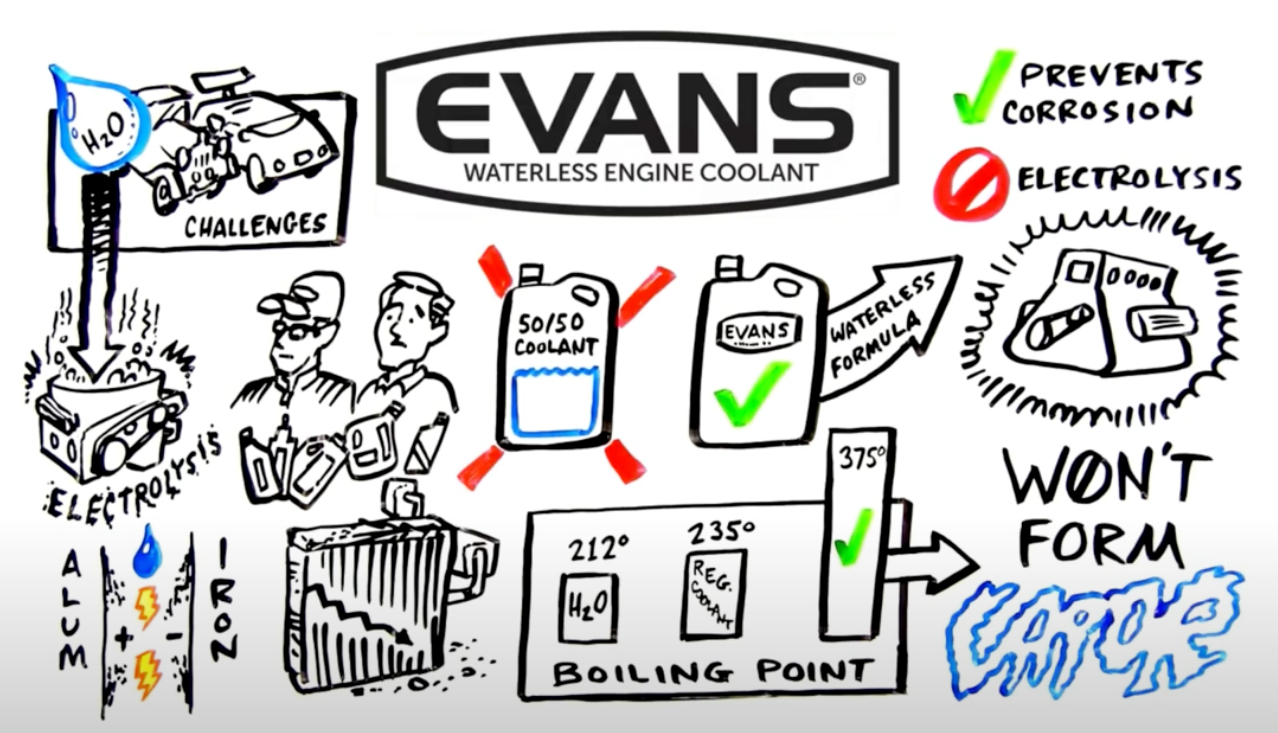
  3. What is bad about water in a coolant? The boiling point of water is too low. There is very little separation between the operating temperature of the coolant and the boiling point of water for the pressure of the system. The boiling point of water is the failure temperature of the cooling system. Water vapor has almost no thermal conductivity. Water is aggressive toward cooling system metals and promotes electrolysis between dissimilar metals within the cooling system.

  4. Water-based coolant is mostly 50% glycol and 50% water. Why isn’t the failure temperature the boiling point of the mixture, rather than the boiling point of water? Some locations within the cylinder head generate so much heat that some of the nearby coolant boils. When local coolant boils, the resulting vapor is nearly 100% water vapor. If the coolant that is surrounding the water vapor is above the boiling point of water, the water vapor cannot condense. Under this condition, the water vapor makes an insulating barrier between hot metal and liquid coolant, causing the temperature of the metal to spike to high levels.

  5. Why is the vapor from boiling a 50/50 glycol/water mixture (EGW) nearly 100% water vapor? When the mixture is boiled the water part is fractionally distilled, as it is far more volatile than the glycol portion. Water vapor is liberated while the glycol remains in the solution.

  6. What are various boiling points of interest? Water at sea level (1 atm. absolute) boils at 212° F.
    Water at sea level with a 1 atm. pressure cap (2 atm total) boils at 250° F.
    EGW at sea level (1 atm. absolute) boils at 224° F.
    EGW at sea level with a 1 atm. pressure cap (2 atm. total) boils at 263° F.
    Evans Waterless HDTC at sea level (1 atm. absolute) boils at 375° F.

  7. What happens to the boiling points at higher elevations? The boiling points decline as the altitude increases.
    Water at 5000 ft. (0.83 atm. absolute) boils at 207° F.
    EGW at 5000 ft. (0.83 atm. absolute) boils at 218° F.
    Evans Waterless HDTC at 5000 ft. ( 0.83 atm. absolute) boils at 368° F.

  8. What is pump cavitation and how can it occur? Action of the coolant pump creates a low pressure area at the pump inlet. Pump cavitation occurs when coolant near its boiling point encounters the low pressure area and flash vaporizes within the pump. The gas pocket in the pump causes the pump to stop functioning and coolant circulation to stop. Coolant pump cavitation leads directly to catastrophic cooling system failure with the coolant being expelled from the system as steam pressure exceeds the pressure relief setting of the cap.

  9. What is Afterboil? After-boil occurs after shut-down of a stressed engine when the coolant is near its boiling point and residual heat remains in the cylinder head or in an auxiliary circuit such as an EGR cooler. Upon shut-down the coolant pump ceases to circulate coolant through the cooling system. Residual heat boils the stagnant coolant, making steam pressure that exceeds the pressure relief setting of the cap. Coolant is pushed out of the system.

  10. What is the primary purpose of an engine cooling system? To keep engine metal temperatures under control.

  11. What burden must be uniquely borne by a functioning cooling system using any water-based coolant? The cooling system must keep the coolant below the boiling point of water for the pressure of the system under all operating conditions and after shut-down. This task is difficult because the coolant frequently operates close to the boiling point of water.

  12. What is the most important operational feature of Evans Waterless HDTC? The huge separation between the operating temperature and the boiling point of the coolant, on the order of at least 100° .

  13. What is the Reserve Capacity made available by changing to waterless Evans Waterless HDTC? The huge separation between the operating temperature and the boiling point of Evans Waterless HDTC unlocks a Reserve Capacity that already exists in systems designed for water-based coolants. Any cooling system designed to keep coolant below the boiling point of water for the pressure of the system under all operating conditions and after shut-down is liberated from those requirements with Evans Waterless HDTC. When temperatures happen to be higher, there are no failures due to the lower boiling point of water. In a 100° F environment a radiator that is 250° F will dissipate 25% more heat than one at 220° F.

  14. Is Evans advocating operating engines at substantially higher temperatures? Not really. Operating temperatures are normally only slightly warmer than those of water-based coolant. When the engine is stressed and temperatures rise, the cooling system can accommodate that increase in temperature without cooling system failures.

  15. How does Evans Waterless HDTC prevent engine hot spots? The huge separation between the operating temperature and the boiling point of Evans Waterless HDTC provides an environment where any locally generated coolant vapor immediately condenses into adjacent liquid coolant. Vapor cannot build into an insulating barrier, and contact between hot metal and liquid coolant is maintained at all times. Metal temperatures are under control at all times.

  16. How does Evans Waterless HDTC prevent after-boil? After shut-down, the huge separation between the operating temperature and the boiling point
    of Evans Waterless HDTC has the capacity to absorb heat from hot metal parts of the cylinder head Boiling is avoided and there is no build-up of pressure to force coolant out of the system. Stresses on cylinder heads and EGR heat exchangers are avoided as metal temperatures are kept under control.

  17. How does Evans Waterless HDTC prevent pump cavitation? The low pressure area of the coolant pump is never at a low enough pressure to flash vaporize. The pump never gets vapor bound and has the capability to pump coolant over a broad range of temperatures.

  18. How does Evans Waterless HDTC prevent cylinder liner cavitation erosion? Cylinder liner cavitation erosion is a problem in water-based coolant systems. As the piston moves inside the cylinder there is vibration of the liner. The vibration of the liner against the coolant alternately makes low and high pressures. During the low pressure instant, vapor is created by flash vaporization. During the adjacent high pressure instant, the vapor collapses against the cylinder liner. This repeated action causes an attack against the metal liner, resulting in cavitation erosion.

  19. How does Evans Waterless HDTC save fuel? In spark ignition engines Evans Waterless HDTC coolant saves fuel by better control of metal temperatures and the avoidance of hot spots. The consequent reduction of knock permits more efficient spark settings on engines having electronic controls with knock sensing inputs. In heavy duty engines having on-off fan clutches, the “on” temperature can be increased to 230° F, keeping the fan off a large percentage of the time and reducing a significant source of parasitic drag.

  20. How long will Evans HDTC and its additives last? Evans Waterless HDTC coolant will last the life of the engine as long as it is not contaminated with water.

  21. How do the additives in Evans Waterless HDTC remain in solution without the presence of water? Evans Waterless HDTC contains no additive that requires water to dissolve or to enable the additive to function.

  22. How much water is acceptable after a conversion to Evans Waterless HDTC coolant? In heavy duty diesel applications the water content must not exceed 3.0%. Dry engine installation of HDTC is preferred.

  23. How does one test for the percent water content? The water content is readily determined by the use of a refractometer (Evans Part. No. E2190).The following are refractometer readings of Evans Waterless HDTC with corresponding water content percent:

    Brix Reading: Water Percent

    55.70: 0
    55.00: 1
    54.70: 2
    54.40: 3
    54.00: 4
    53.50: 5

  24. How do you calibrate the refractometer? Using a drop of new Evans Waterless HDTC, adjust the Brix reading to 55.70.

  25. Evans Waterless HDTC contains a blend of glycols, including ethylene glycol, which is toxic. How toxic is Evans Waterless HDTC? Evans Waterless HDTC contains a substance that inhibits the metabolism of ethylene glycol, preventing its toxic metabolites from forming. In tests on rats according to EPA regulations, no rats died eating Evans Waterless HDTC, even in quantities that completely filled the stomachs of the rats, indicating a very low oral toxicity.

  26. If Evans Waterless HDTC is so low in oral toxicity, why is there an ethylene glycol warning on the bottle? The U.S. Consumer Products Safety Commission requires the ethylene glycol warning on all products that contain over 10 percent ethylene glycol. Permission to waive the labeling requirement requires tests on human tissue that have not yet been performed.

  27. How much power does the radiator fan for a typical heavy duty engine use? According to the Cummins MPG Guide (February 2007), the fan for an ISX engine draws 17, 26, 37, and 52 HP at 1300, 1500, 1700 and 1900 RPM, respectively. (Fan horsepower relates to RPM by Fan Law #3.)

  28. At what temperatures do the fans for heavy-duty engines turn on and turn off? Typically, the fans turn on around 200° F-210° F and off between 180°F and 190°F.

  29. Why are fan temperatures set so low? Fan temperatures are typically set low enough so that water based coolant can act as a heat sink to absorb residual heat, preventing an afterboil situation, at idle or shut-down following a stressful run.

  30. Do low fan temperatures cause the fan to run more of the time? Yes, low fan temperature settings cause extended “fan-on” intervals as compared to higher fan temperature settings. Heat transfers more efficiently from a hotter radiator to the ambient air than from a cooler radiator. The fan does not have to run as long to transfer the same amount of heat.

  31. Obviously, running the fan less will save fuel. How can Evans Waterless HDTC be used to reduce “fan-on” time? There is ample capacity for the coolant to absorb residual heat from both the cylinder head and the EGR cooler without causing boiling and other after-boil problems. With Evans Waterless HDTC the fan-on temperature can be safely increased to, say, 230° F, reducing the “fan-on” time. Keeping the radiator fan “off” more of the time reduces fuel consumption significantly.

  32. How is the “fan-on” temperature raised? There are no internal hardware or software changes to the engine control module (ECM). A coolant temperature sensor (thermistor) that is similar to the one in use is tested to determine its resistance v. temperature profile. The additional resistance that would be required for the fan to turn on at 230° F is computed. A ResistorPac of that value is placed in series with the coolant temperature sensor. Evans Cooling Systems, Inc. is happy to provide further information or guidance on request. The fan will then turn on at 230° F.

  33. The fan is needed for functions other than for controlling coolant temperature. What happens to the charge air temperature and the head pressure for the a/c system when the input signal to the ECM is altered for the coolant temperature? The fan will still respond to the conventional settings for charge air temperature and for the a/c head pressure. Typically, these functions do not require nearly as much fan as required for maintaining coolant temperatures.

  34. Can higher temperature coolant thermostats be used with Evans Waterless HDTC for additional gains in fuel economy? Yes. SAE Type II testing was performed by the PAVE Research Institute at Auburn University that proved a 3 percent improvement in fuel economy with Evans waterless coolant and 215°F thermostats.

  35. Are there additional requirements for using 215°F thermostats? The fan-off temperature must be increased so that the coolant does not have to be cooler than 215°F for fan-off. Contact Evans Cooling Systems, Inc. for further information.