
Circle Track Magazine - August 1997
"New Coolant Technology Wins Races"


press page midway page 2 page 3 page 4 page 5
to the end
Circle Track Magazine - August 1997

New Coolant Technology Wins Races
By Robert Eckhardt

While gaining horsepower by changing your cooling system may seem far-fetched, some say it is possible. Jack Evans, of Evans NPG Cooling Systems, is one of these people. He has been developing an improved cooling system that allows an engine to operate at higher temperatures using more of the heat of combustion for power production.

THE SYSTEM

So, what is this new cooling system and how does it work? There are three basic components: a non-aqueous propylene glycol (NPG) coolant, a high volume NPG coolant pump (water pump), and a zero-pressure radiator. These were designed to meet the problems caused by the use of water in the cooling system.

Coolant image

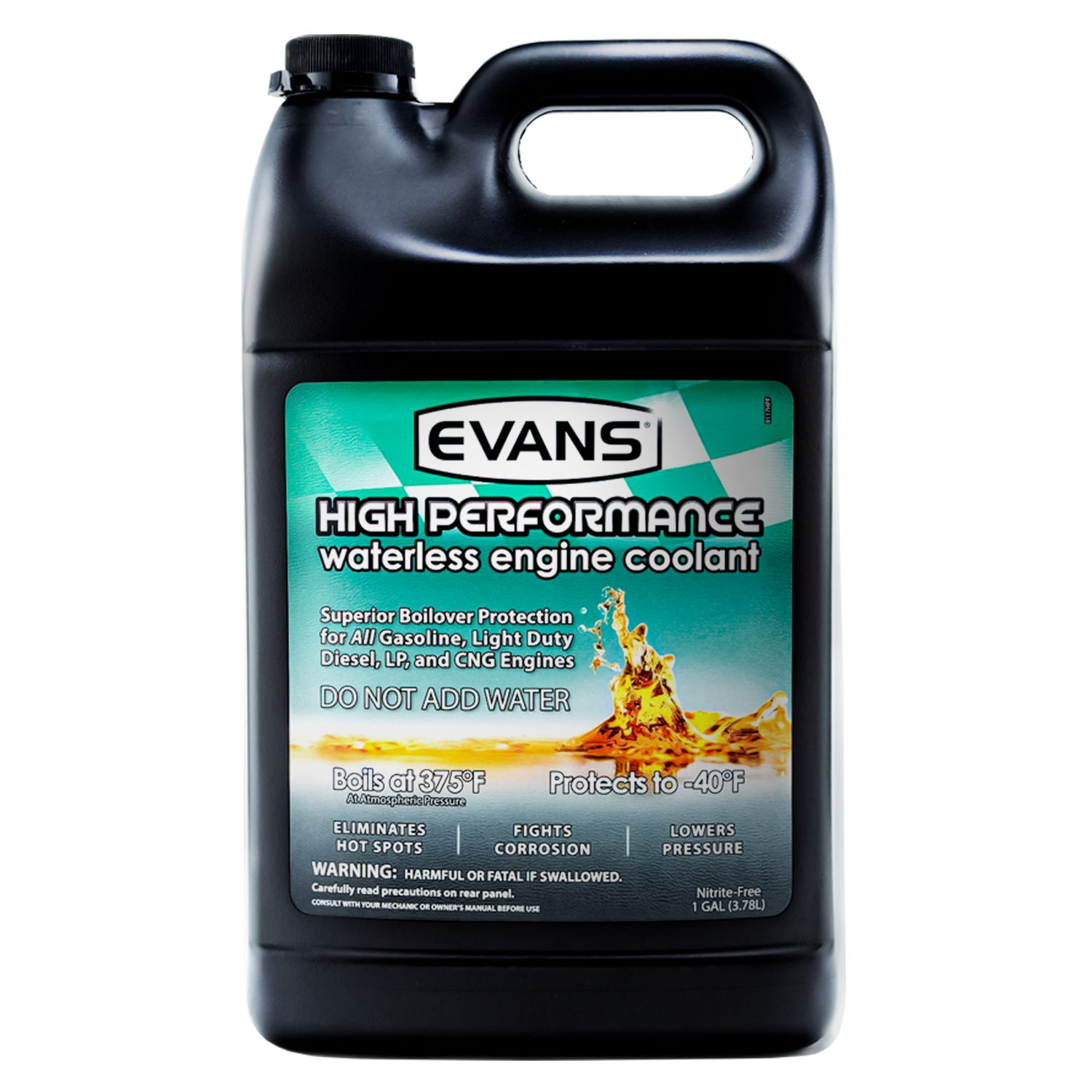
The heart of the Evans cooling system is the non-aqueous propylene glycol (NPG) coolant - A patented formula.  Other propylenes will not work in the same manner because they are made to mix with water.

(Robert Eckhardt Photo)

In order to better understand how this coolant can save your engine, it's important to know what is going on inside the motor. Inside the combustion chamber and at the top of the block there are tremendous amounts of heat being generated by compression and ignition. The heat is not uniform across the entire area, though-- there are "hot spots." This is the root of all the problems. As the coolant comes in contact with the hot spot, it boils. If the temperature exceeds the boiling point of the coolant, then you have what is called "nucleate boiling." The liquid coolant turns into vapor and forms a blanket which covers the hot spot. The vapor blanket keeps the coolant from coming into contact with the hot metal and adequately cooling that spot. This causes the spot to grow and become hotter--and the vicious cycle continues. More coolant vaporizes allowing more heat expansion and higher temperatures continuing until you have pre-ignition, loss of power, burnt pistons and a blown engine.

Jack Evans explained what he's found in his years of testing, research and development with his own race cars and in his tests with Detroit’s Big Three automakers.  He said, “Water makes tremendous volumes of steam which elevates cylinder head metal temperatures.  The only way to get the heat out is to go to some kind,of boil. Boiling will carry 10 times the heat as it changes from a liquid to a vapor and back to a liquid again. Ideally, you use the nucleate boiling point of the coolant as the control point at which you need to keep the temperature of the critical metal, or, hot spots. If the coolant uses water, you'll go beyond nucleate boil. The coolant can't get the heat out of the metal, and then it starts to cook. More and more mass heat develops which causes the cooling side of the chamber to get hot which results in the boiling of more and more coolant.”

Pump image
In order to achieve the higher flow rates necessary to use the NPG coolant, Evans needed to design their own pump.  The pump on the right is for a small-block Chevrolet.  Note the larger diameter impeller and impeller cavity.  Also the inlet is larger.  The backing plate has been rotated so that the bolts do not interfere with the flow of the coolant.

(Robert Eckhardt Photo)

to the top1


NUCLEATE BOILING

"With our system, you still have boiling, but it remains in the very early stages of nucleate boiling.” Evans continued, "Propylene is a low surface tension fluid, so its bubbles will break away from the surface very quickly. It has less affinity to merge with other nucleate sites which would otherwise develop into larger bubbles on the surface of the metal. So with higher flow rates and lower surface tension, we knock the small amounts of nucleate sites off the surface. We have higher thermal efficiency with NPG at the boiling point than does water. The terminal molar heat of a fluid is measured in British thermal units (Btu’s) of heat. Water is 9,300 to 9,400 Btu's. Propylene is 14,000 to 15,000 Btu's. We transfer a lot more heat out of the metal keeping the nucleate sights smaller.

"As a result of the testing we've done on our dynos and in our work with Detroit OEMs, we've been able to identify how much vapor is on the surface and how much is in the radiator. Every time you build that gas bubble, it gets in the way of heat exchange. It also starts to cavitate the pump and slow down the flow. It's an evil cycle that just gets worse and worse. Using our coolant, there is less of a creation of vapor and we have better liquid control all of the time."

Evans continued, "Controlling the temperature at the hot spot is important because, as the nucleate site changes to surface-vapor, it gets bigger and bigger preventing the heat from escaping out of the metal. It gets hotter and hotter until it effects detonation, which leads to pre-ignition. The temperature of the coolant inside the water-cooled engine needs a difference of 20 degrees below the boiling point to get the vapor to convert back to liquid. Normally, you're only getting a 12 to 14 degree drop in cooling out of the radiator.

"As that nucleate sight worsens, you get advanced levels of detonation all efficient engines detonate. Detonation occurs five to 10 degrees after top dead center (TDC), which is normal. You have to control that detonation point to make the engine effective. Without any control, the engine is lighting-off too late to get any real power. The occurrence of detonation heats the hot spots more and more. So you're creating additional heat with each advancing level of detonation. If you go lean, have a bit too much advance, or run too hot, then the detonation starts to move back toward TDC. As it does this, it puts more heat into the engine forming a secondary flame-front. You now have the spark flame-front and the detonation flame coming together. Cylinder pressures increase, making power but also making more heat.

"You've finally overworked the engine when that detonation starts going back over TDC and the second flame-front occurs before top dead center (BTDC). That causes pre-ignition. That is when everything starts to come apart.

Radiator image

The zero-pressure Evans radiator is designed to flow about 90 gallons per minute. They have radiators,with two rows of 1, 7 7/4, or 1 7/2inch tubes depending on the engine's horsepower, The radiators are 79 inches tall by 24, 26, 27 7/2 or 31 inches.  All the radiators have 18 fins per inch. Evans will also customize a radiator for your special requirements.

(Robert Eckhardt Photo)

Then you start to throw massive amounts of heat into pistons and the head. At this point, you typically burn through or throw a piston out of the engine. You can also crack a cylinder head or blow a head gasket." Evans asserted.

"By controlling the cylinder head metal hot spots, we keep the engine within detonation limits, all the time. Even with high-compression engines that run hotter, we are still staying at the nucleate boil point and keeping the liquid in contact with the metal. That way we don't build the vapor dome. We stay nucleate, scrub the vapor away and keep that region under control staying on the safe detonation side of TDC. We don't let it overheat a spot and become an origin for pre-ignition. That is the whole difference between a water based system and our NPG system."

Flow bench image

Evans uses a large electric motor to test flow rate of the pump and the heads.  They're also tested to determine where specifically hot spots occur.

(Robert Eckhardt Photo)


Dyno image

Extensive dyno testing assured that the NPG pump adds more horsepower potential than it takes away.  Evans also uses the dyno's sensors to track where every Btu of heat is distributed in the engine.

(Robert Eckhardt Photo)

to the top2


PROPYLENE GLYCOL

Next, we wanted to know what properties in Evans' non-aqueous propylene glycol make it special. In looking at the spec sheet, the first thing that pops out is the fact that its convection of heat transfer is one-third lower than that of water. With propylene glycol's low heat transfer characteristics, you would think the NPG would not be able to get the heat out of the engine.

We asked Jack Evans about this point. He said, "We found that getting the heat out of the engine is based on flow, specific heat, and the characteristics of the fluid. We discovered that, by adjusting the flow, we could get a lot of the convection transfer rate back.  We knew if we kept the pressure drop (Delta P) across the engine very low, we could get a lot of flow through the engine. When we do that, it brings back the convection transfer.  
 
If we have one-half of the characteristics of heat transfer, we have to theoretically double the flow in order to get the same heat into the coolant. However the increase is usually only abut 30% over the water flow rate. "So now we need a radiator that doesn't build a lot of pressure. If you took our NPG pump flow rate and ran it through a conventional radiator, it would create a lot of pressure in the inlet tank rather than move flow. With this pressure, we can't get the coolant through the system fast enough. Once we have a radiator that will get the heat out of the coolant at the higher mass flow rate, we'll have picked up our convection number."

Evans went on to say, "The current racer's mind-set is: After 180 to 200 degrees, you start to lose power. That is true with water. As advanced detonation lets pre-ignition set in, it creates a reverse sonic wave-pulse going back up the intake. This wave affects the breathing of the engine. A hot engine really should not lose power as long as you don't affect its breathing. With our system, we can run hotter temperatures and not have the car lose power. We do have a drop in volumetric efficiency, however, we don't have any dramatic movement back to TDC and in the pre-ignition zone. So the cylinder breathes better, stays more fuel-efficient, and the burn time is increased making more power when hot.”

Radiator image

The Evans NPG cooling system consists of the non-aqueous coolant, the high-volume NPG coolant pump, and the zero pressure high flow radiator. You can run the coolant by itself in low horsepower engines. With increased power you will need the increased flow of the pump and radiator. (Robert Eckhardt Photo)


Radiator image

Extensive dyno testing has assured that the NPG pump adds more horsepower potential than it takes away. Evans also uses the dyno's sensors to track where every Btu of heat is distributed in the engine. (Robert Eckhardt Photo)

NPG VS. PG

Are all propylenes created equal? Evans' answer was “definitely not." He went on to say, "Our patented formula is different from other propylene glycols. Water-blend PG's inhibit acid by putting in buffering additives like phosphates and borate, to get the pH up into the 10 to 14 range. We have no problems with acids, so we start at about a pH of six.  Their coolants require water to keep the additives suspended in the system.  Without the water buffering the additives, they are unstable and will fall out.  This can plug up the radiator and has an abrasive effect on the impeller and radiator core.  We formulated our coolant to work without water. The difference between coolants is the additive package. Our coolant is a patented product formulated for racing."

(continued p4)


Brett Hearn

The custom radiator on Brett Hearn's car is built to keep his big block cool with minimal air flowing to it.  Evans has a bleed valve at the top of their pump and radiator to remove all air from the system.

(Robert Eckhardt Photo)


In the January 1990 issue of Circle Track, we introduced Jack Evans and his propylene system. Because of time-consuming patent infrigement lawsuits, he has had to file to protect his research. Evans has not spent a lot of time on marketing. His earlier systems were a reverse-flow design. He has sold over 2,600 of those systems. In the seven years since the first article, he has refined his standard-flow design. One of those early systems went to Brett Hearn, the 1996 Skoal Dirt Modified Champion. Brett started using the system in 1992. When asked what benefits he has recieved from using Evans' products he said, "The biggest thing we looked at was the insurance it gave us when we plugged-up 20 to 30 percent of the radiator. We look to keep the nose of the car as closed-up as we can. So anytime we open a grille to get air to the radiator, we run the risk of losing radiator capacity because of accumulation of clay. This system is a way of guaranteeing that we don't boil of the cylinder head. We like to see 205 to 220 degrees coolant temperature. I'm comfortable with that. The highest we have ever seen is around 260 without any adverse effects on the engine.

"Since I pay my own bills, and engines are our biggest expense, there are two things we say when we get a new engine: It should go well over 1,000 laps if we don't heat it up by losing the coolant, and we don't throw any dirt down the air cleaner. If we can keep those two things away from the engine, we are going to cut our engine bill dramatically. We have gotten as many as 1800 laps between rebuilds.

"My engine builder feels that once you have done heat damagage to the cylinder head, the engine will show a noticeable decrease in performance on the dyno, even after it is rebuilt. If you get it hot once, you can fix it but it will not be as good as it was when it was new. Heat takes the strength out of the aluminum."

to the top3


Since the NPG works without water and is in a non-pressurized environment, we asked if there were any concerns about the coolant becoming contaminated by water in its normal use? Evans explained, "The vapor point of water is so high compared to the NPG that the water, at temperatures above 90 degrees, evaporates out of the coolant instead of being absorbed into the coolant. That is the transition point where water goes out so fast it actually dries the coolant instead of pulling water in from the atmosphere. Also, our boil point is so high, it is easy to stay far below the condensation point. At 200 degrees, our coolant is 170 degrees below its boil point."

COOLANT TEMPERATURE

Horsepower causes heat. We've been told for years that because water boils at 212 degrees you have to keep your water temperature below 200 degrees. Now Evans is telling us 230 degrees is what we should be running. In fact, 260 degrees is perfectly safe using his system. For most drivers, to believe that will take a leap of faith. Evans understands. He said, "It is hard to preach running hot. The way to look at it is: We are offering insurance. If something causes the engine to run hot, we have a tremendous latitude of protection. Take dirt cars, for instance, when their radiators get clogged up with dirt, they will no longer have to come in for a pit stop or risk blowing an engine. Or, if your car picks up a piece of paper and it's strewn across the radiator and the temperature goes to 240 or 260 degrees, with our system, it doesn't matter.

"The average race engine has a 12:1 compression ratio" Evans said. "Coolant temperatures in the range of 200 to 230 is where we like to see the engine run. You don't need to go down to 180 degrees. To run at 180 degrees, you have to get mass air to the radiator. When you do that you are giving up aerodynamic advantages. Air is drag. It will slow down a car.

"Because of the capability to run at much higher coolant temperatures you can add more power to your engine, add compression and run a lot leaner.  With most water systems, compression ratios of 14:1 and 15:1 are taxing the system and you are running on the ragged edge.

We found in our test cars that we can run 16:1 compression at full advance and run higher temperatures without detonation.”

"In the future," Evans asserted, "we have to educate the racer that 220 to 230 degrees is acceptable. He needs to accept that water at 180 degrees, and the NPG system at 230 degrees, are the same. Also he must accept that at 260 degrees with our system, he will not blow his engine. When he understands our system, he will have 50 more degrees to improve the performance of his vehicle. More power will give him more heat but he'll be able to control it. "In limited classes, like Street Stock, where you can't increase horsepower with compression and carburetion, you can start closing off the front end to gain a performance advantage. By using the NPG, you can run hotter safely."

OIL TEMP

Running higher coolant temperatures makes sense if you can control it, but what effect does the higher temperatures have on oil temperatures? Evans' answer comes from his testing with Detroit's automakers. Evans said, "Chevrolet is now saying we should be running the oil temperature at 220 to 240 degrees. If you're not, you are giving away horsepower. We have learned to stay below 260 to 270 degrees because the life of the oil starts to fall off. The people who run 180 degrees need to know that it is not good for the bearings. The oil is too thick. The rings are plowing through it and the pump is pushing it, both of which rob horsepower."

NEW PUMP

To get the flow rates Evans Cooling needed for their system, they had to design a new pump that would be a bolt-on piece. Evans detailed some of the work that went into this project saying, "For years we have taken stock pumps and spun them faster to get the flow rates we wanted. We spun some pumps twice as fast to get our desired flow. When we got the flow we wanted, the pump bearing, accessory drives, and belts started failing. We were spinning the pump so fast, the mass inertia worked against us. So we decided to cast our own pump to get the volume we wanted at acceptable pump speeds. A centrifugal pump's efficiency is most affected by its diameter. We opened up the pumping diameter and designed an impeller with big blades to move more volume. In a small block Chevy at 7,000-8,000 rpm, for example, we like to pump 90 gallons per minute. So, now we have a pump that gives us the volume and flow we want and you don't have to change your existing pulleys--it bolts right up.

"We've opened up the pump's inlet and outlets, moved the cover bolts out of the flow, and added bosses at both legs so it can be drilled and taped for external lines. There is an air bleed at the top of the pump, to purge all the air out. Once the pump is full, it will stay full. You are not going to cavitate or trap vapor in our pump."

Evans Cooling Systems, Inc.
Comparison: 50/50 EGW and Evans NPG
Boiling Point   Water 50/50 EGW Evans NPG
         
 
252
(@ 16 psi)
268
(@ 16 psi)
369
(@ 0 psi)
Viscosity

(50°F)
(176°F)

(212°F)
cp  

1.2

0.37

0.28
 

5.0

0.96

0.7
 

115.0

4.5

2.35
Density
(77°F)
1lbs./gal.
8.34
8.84
8.59
SpecificHeat

(176°F)

(212°F)
cal/g.K  

1.0

1.0
 

0.86

0.88
 

0.68

0.71
Heat of
Vaporization
cal/mol
9,700
9,800
12,500
Vapor Pressure (176°F) hPa
490
400
11
Surface Tension
(77°F)
dyn/cm
72
56
36

to the top4


Brett Hearn

Brett is king of the dirt in the Northeast modifieds. Hearn keeps his radiartor opening as small as possible for two reasons. The bigger the opening, the greater the chance of clay plugging up the radiator Secondly, he hass trust in the ability of Evans's product to keep his engine running with temperatures that would cook the competition. The only thing that cooks in Hearn's cars is Brett.

(Robert Eckhardt Photo)

ZERO-PRESSURE RADIATOR

"In order to get flow and not lose horsepower," Evans continued, "we are very concerned about pressure drops across the radiator. Since we get a lot of flow from the pump, we do not want to create pressure at the inlet of the radiator. In order to minimize the pressure, we have to maximize the cross-sectional area of the radiator tubes to flow more through it. At the same time, because of the viscosity of the NPG, it wants to go into laminar flow. The smaller the tube, the more the NPG wants to stay in the center. If the coolant in the center doesn't touch the walls, you lose heat exchange. The cross-sectional tube width is very important.  We find that if we have a high aspect ratio tube like our 1 1/4 inch tube, the coolant going through will turburlate itself or tumble and mix going through. We wind up with a better heat exchange rate than most of the tubes used today. We also wind up with a deeper core.

"We are very conscious of the air flow through the radiator. We run a different fin-per-inch density in order to maximize the air through the radiator. This way we get the heat exchange we want without creating additional drag. Every time you have excessive fins, they cause air drag. Our fins and radiator tubes are balanced to work together.

"We vent the radiator for our zero pressure cooling system. The filler cap is a screw-on, zero-pressure cap with a vent built into the neck. We balance the ability of the radiator to diffuse the heat produced by different horsepower engines with different size radiator tubes. A Saturday night radiator is different from a speedway radiator.  Think of air at 200 verses the speeds on a short track, it is totally different” Evans said.  “Cup teams have different radiators for each track, based on the radius of the corners and length of the straight-aways.  We know they are using a variety of fin densities.”

The chart compares straight water, a 50/50 mix of ethylene glycol and water, and Evans’ NPG.  The Evans coolant gives the racer 117 more degrees of boiling protection.  The boiling point of the liquids is very important but that is not the only issue.

The specific heat shows the difference in convective heat transfer from a hot surface to a liquid flowing over that surface. Water can transfer a third more heat than the Evans NPG. This is the reason Evans had to design a new high-volume pump. They increased the flow rate of the coolant to match the heat transfer rate of water.

The heat of vaporization shows that the NPG can extract 25% more heat than water at the point of boiling. It also shows that it is less likely to vaporize. Liquids cool hot metal, not vapors. When vapors are formed, it is important to have them recondense back to a liquid quickly. The lower the vapor pressure, the easier it is for the vapors to recondense. The NPG's very low vapor pressure means it can recondense vapors back to liquid 50 times faster than water.

The surface tension of a coolant should be low because you want the liquid to break away from the hot surface and mix with the cooler liquid flowing through. The NPG has a surface tension characteristic that is half that of water. Water wants to hang on to the surface which increases its temperature and causes the formation of vapor. The NPG breaks away and recondenses back with the bulk coolant.

Evans summed it up best when he said, “Fighting the vapor is the gremlin.  What we have done is improve the liquid contact with the engine.  This improves cooling because there is more coolant touching the metal at all times and it will take more heat away.  It’s simple physics – there’s no black magic here.”

MANUFACTURER
Evans Cooling Systems, Inc.
255 Rte. 41 North
Sharon, CT 06069
USA
(860) 364 5130

to the top
 
press page midway page 1 page 2 page 3 page 4

to the top